Data restored from a 1981 survey shows that Iowans generally favored diplomatic solutions and providing aid over direct military action or nuclear threats if Russia were to invade Poland. These data come from Iowa Poll #248, a random sample survey of Iowans from April 1981, which has been restored as a part of a larger IPOL project to recover lost data from past Iowa Polls.
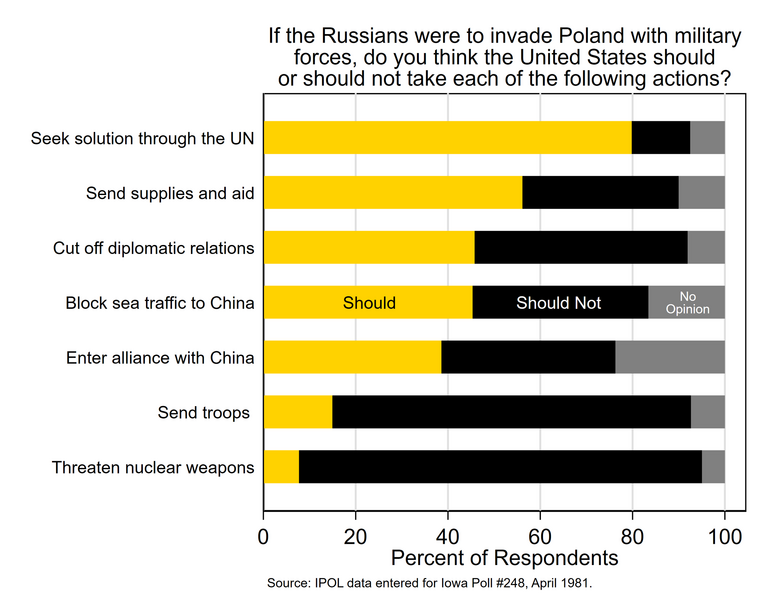
Iowans were asked, “If the Russians were to invade Poland with military forces, do you think the United States should or should not take each of the following actions?” Most Iowans said the U.S. should seek a solution through the United Nations (79.8%) and should send military supplies and economic aid without troops (56.1%). Very few said the U.S. should threaten nuclear weapons (7.7%) or should send troops to defend Poland (15.0%). Responses were more evenly split on other actions. 45.8% said the U.S. should cut off diplomatic relations with the Soviet Union versus 46.2% who said should not. 38.6% said the U.S. should enter a military alliance with China versus 37.7% should not. 45.3% said the U.S. should block sea traffic to and from China versus 38.1% who said it should not, with 23.7% and 16.6% responding don’t know for the alliance and sea blockade questions, respectively.
Across most demographic groups, including religion and party identification; responses were relatively consistent; For the question about whether the U.S should enter a military alliance with China, there was a notable difference when comparing response distributions by sex; almost half (47.2%) of men supported it, while about a third (34.6%) were opposed, whereas well under half (30.7%) of women were for the alliance and 40.6% were opposed to it. A sizeable proportion of both groups – 18/2% of men and 28/8% of women – indicated they didn’t know if the U.S. should enter such an alliance.
Iowa Poll #248, conducted by the Des Moines Register, was administered to a random sample of Iowans in April 1981. In addition to the questions about a possible invasion of Poland by the Soviet Union, the survey asked respondents their opinions on a wide variety of topics, including the recent assassination attempt on President Reagan, personal finances, school spending, smoking habits, and handgun control. Understanding Iowans’ past opinions on these topics can help us understand how perspectives have changed and what ideas have remained popular. IPOL has also been working with UI Libraries and the Des Moines Register to restore data from dozens of Iowa Polls from the 1960s to early 1980s. More information about the project can be found here. We are working to release a full report on our findings as we analyze additional questions.