Results from Iowa Poll #248 revealed that Iowans were split on whether they would expect to be trusted to return to a restaurant and pay if they had forgotten their wallet. Data from Iowa Poll #248, a random sample survey of 1011 Iowans in April of 1981 was recently restored by students in IPOL.
Considering whether they expect to be trusted to return by the manager of a restaurant and pay for their meal, Iowans were divided. The edge went to the Iowans who felt the manager should trust them to return: 48.3% of those surveyed believed in their trustworthiness compared to 47.7% who did not expect the manager to trust them. 4.0% said they did not know. In a separate question, one in five Iowans reported that this or something similar had happened to them before.
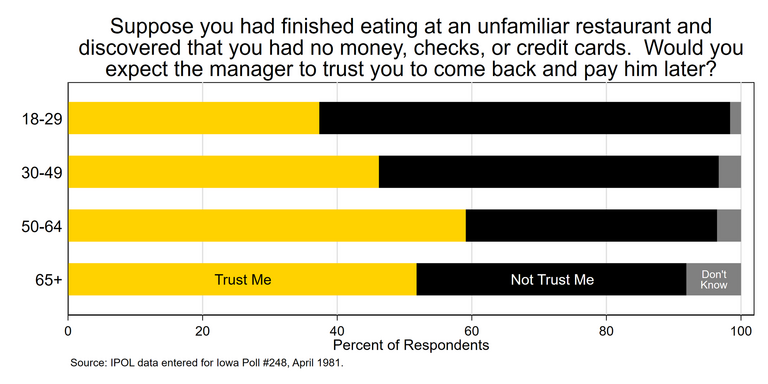
When compared with age, the older generations believed that they should be trusted to return. In the age group 50-64, 59.1% felt they should be trusted, while 51.8% of those 65 and older felt the same. The majority of younger age groups believed they should not be trusted, as between the 18-29 age group and the 30-49 age group, only 37.3% and 46.2% believe they should be trusted to return, respectively.
With respect to education levels, those who finished high school were less likely to feel that the manager should trust them to return than their less-than-high-school-educated and college-educated counterparts. Among responders with a high school education, 46.8% expected the manager to trust them. For those who did not finish high school, that number rose to 49.5%, while college-educated just barely beat them out with 49.6% expecting the manager’s trust.
Iowa Poll #248, conducted by the Des Moines Register, was administered to a random sample of Iowans in April 1981. In addition to the question about trust, the survey asked respondents their opinions on a wide variety of topics, including the recent assassination attempt on President Reagan, personal finances, school spending, smoking habits, and the U.S. response to a hypothetical invasion of Poland by the Soviet Union. Understanding Iowans’ past opinions on these topics can help us understand how perspectives have changed and what ideas have remained popular. IPOL has also been working with UI Libraries and the Des Moines Register to restore data from dozens of Iowa Polls from the 1960s to early 1980s. More information about the project can be found here. We are working to release a full report on our findings as we analyze additional questions.