A 1981 Iowa Poll asked Iowans if the number of children they have would change if they had to do it all over again. The restored data indicates interesting differences in responses across respondent age groups and the number of children they had. This data comes from survey #248, a random sample of 1,011 Iowans from April 1981, which has been restored as part of a larger IPOL project to recover lost data from past Iowa Polls.
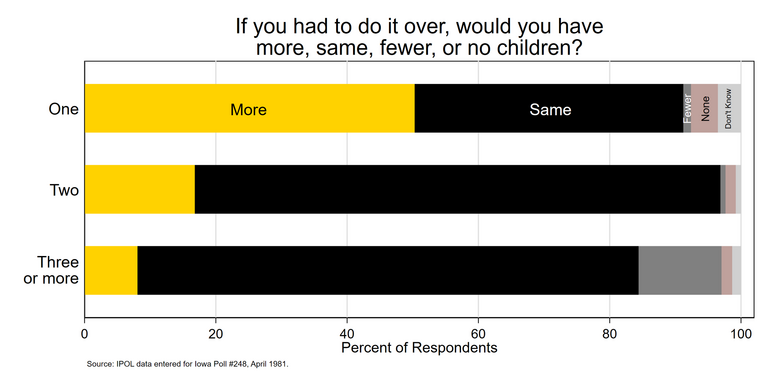
Looking only at respondents’ answers to changing the number of children they had, about 70% of respondents said they would have the same number of children, around 20% said they would have more, and only small percentages said fewer (about 6%) or no children (about 2%). The results varied depending on the number of children and age. People with one child were much more likely to say they would have more (about 50%), while those with two or three children mostly said they would have the same number (around 76–80%). Age further differentiated respondents’ answers. Out of all age groups, younger respondents (ages 18–29) were more likely to want more children (27%), while older groups were more likely to stay with the same number. This ultimately reveals a trend that satisfaction with family size tends to increase once people have two or more children and as they get older.
Iowa Poll #248, conducted by the Des Moines Register, was administered to a random sample of Iowans in April 1981. In addition to the questions about children, the survey asked respondents their opinions on a wide variety of topics, including the recent assassination attempt on President Reagan, personal finances, school spending, smoking habits, and handgun control. Understanding Iowans’ past opinions on these topics can help us understand how perspectives have changed and what ideas have remained popular. IPOL has also been working with UI Libraries and the Des Moines Register to restore data from dozens of Iowa Polls from the 1960s to early 1980s. More information about the project can be found here. We are working to release a full report on our findings as we analyze additional questions.