On March 30, 1981, President Ronald Reagan was shot and seriously wounded by would-be assassin John Hinckley Jr. Similarly, there have been multiple attempts on President Donald Trump’s life in the past two years. In 1981 the Iowa Poll 248 asked respondents from Iowa a series of questions related to the assassination attempt. In order to see how opinions have shifted since then we placed four of the questions on a recent survey. Respondents in a 2026 U.S. national poll were asked if they agreed or disagreed with these four questions: “the President should be required to wear a bulletproof vest whenever he is in public”; “The President should not appear in public, except on rare occasions”; “The risk of assassination is a price that is worth paying to keep a President in contact with the people”; and “Convicted assassins and other murderers should be executed in public as a deterrent”. Overall, responses showed modest shifts, with the most notable trend being an substantial increase in the percentage that answered “No Opinion”.
In 1981, 64.6% of participants answered “agree” with the statement about wearing a bulletproof vest, while 29.4% disagreed, and 6.1% provided “no opinion” on the matter. However, in 2026, over one fourth of those surveyed answered “no opinion” (27.6%). Only 49.0% of participants agreed the President should be required to wear a bulletproof vest in public, while 23.4% did not agree. This marks a 16-point shift from “agree” to “no opinion” and a 6-point shift from “disagree” to “no opinion” since 1981. In other words, respondents are much more likely to have no opinion on whether the President should wear a bulletproof vest in public now than they were 45 years ago.

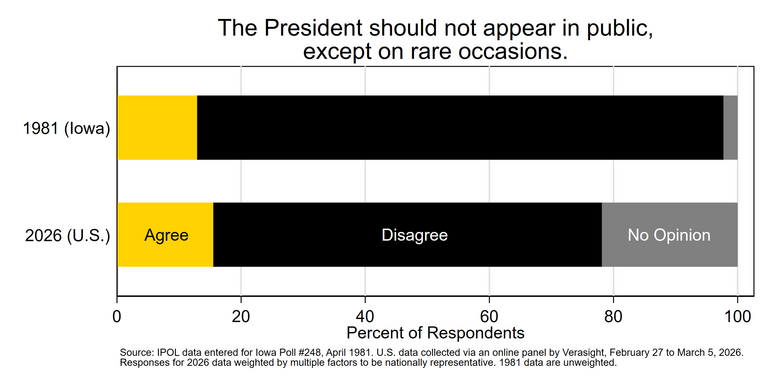
Moving to whether the President should appear in public at all, Iowans in 1981 broadly disagreed (84.8%), with only a small portion answering “agree” (12.9%) or holding no opinion (2.3%). In contrast, modern Americans are much more likely to hold no opinion (21.9%). Despite the increase in “no opinion” answers, respondents from the 2026 poll were also more likely to think that the President should only rarely appear in public: 15.5% agreed, while only 62.6% disagreed. That marks a 2-point increase in support for rarer Presidential public appearances between 1981 and 2026, while opposition fell by 22 points.
When asked whether they agreed that the risk of assassination was a price worth paying, most Iowa respondents in 1981 agreed with that statement (70.9%), while the rest disagreed (21.2%), and only a small portion answered, “no opinion” (7.8%). Contrast this with the 2026 results, in which 53.3% of respondents agreed that keeping the President in contact with the people was worth the risk of assassination, a 87-point fall. The number of respondents who agreed increased by one point to 22.2%, and the number who answered “no opinion” shot up 17 points to 24.5%.

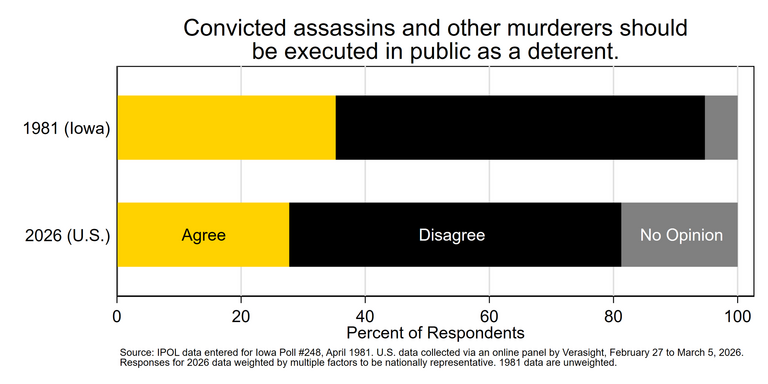
Lastly, public opinion seems to have shifted on whether convicted assassins should be executed in public. 27.8% of U.S. respondents in 2026 agreed with the statement, compared to 35.3% of Iowans 45 years ago. Curiously though, fewer respondents opposed public executions of assassins today (53.5%) than did 45 years ago (59.5%). This comes from an increase in those responding with “No Opinion” from 5.3% in 1981 to 18.7% in 2026.
Iowa Poll #248, conducted by the Des Moines Register, was administered to a random sample of Iowans in April 1981 and includes 1011 responses. We re-ran these questions by placing them on a national survey of U.S. adults fielded from February 27 to March 5, 2026 that yielded 1000 responses. Responses for 2026 data are weighted by age, race/ethnicity, sex, income, education, region, metropolitan status, and partisanship to be nationally representative. Support for 2026 data collection was provided by the Center for Social Science Innovation at the University of Iowa through its Survey Harvest program.